Wish you were here?
Monday, November 21, 2011


Friday, November 11, 2011
Paving of the Roads to NatureWalk commences
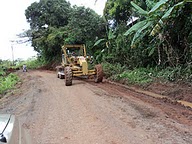 Pavement of a section of the road through the town of Montielimar has now started. This is full concrete paving which means that the village will ultimately have one of the best roads in Costa Rica.
This is a very important step in the evolution of Naturewalk as it represents the paving of the first section of the road to Naturewalk.
 Our town of Pavona (Naturewalk 2 surrounds Pavona) is slated for the same paving in March or April of 2012 giving Naturewalk its first paved concrete access roads. The paving should extend to the site of the Naturewalk horticultural and botanical gardens.

PRG will be investigating the extension of the road all the way up to Estancia Montana.
PRG met with the local president of the Pavona association on the 3rd of November 2011 and he informed them that a regional group of towns including Montielimar and Pavona meet monthly to discuss items of common interest. At the meeting on the 2nd of November 2011 the subject of SAFETY RAILS came up and the group has decide d determined to lobby CONAVI (Consejo Nacional de Vialidad – the National Roads Authority) to install them citing their own safety concerns. So this appears to also be headed in the right direction and PRG will be lending their support to these initiatives.
In the pictures you will notice construction of a number of under road drainage and collection box systems. The pictures are of La Delicious north of Naturewalk and this improvement is moving south towards Naturewalk. Four of these large culverts have recently gone into Naturewalk and the collection box construction is next. These dramatically improve the drainage and thus the overall condition of the roads to deal with the rainy season water. Paving of any roads will not commence until these works are dealt with.
CONAVI have also committed to a new general road base through the general area 21 centimeters of gravel over the whole road. This will then provide an excellent base for our further paving works which PRG are planning.
END OF REPORT
Naturewalk
Tim Alexander
PRG Canada
Thursday, November 3, 2011
Jatropha biodiesel, “one of the best alternatives” for the american continent
This has been the conclusion of the videoconference “Presentation of the Jatropha curcas L. network for investigation, development, and innovation in the production of biodiesel in Latin America and the Caribbean,” organized by the Hemispheric Program in Agroenergy and Biofuel of the Interamerican Cooperation Institute for Agriculture (IICA).
Representatives of technology and investigation centers, ministries of agriculture and environment, universities, international organisms and private companies from Argentina, Brasil, and Costa Rica participated in the event.
According to Orlando Vega, “the video-conference served as a place to address common problems and to identify collaborative work opportunities.”
For Jamil Macedo, director of the Agricultural Investigation and Innovation Cooperative Program for the South American Tropics (Procitrópicos), “even with its limitations, Jatropha curcas L. plantations, is one of the best alternatives for biodiesel production” in the hemisphere.
Investigation institutes from Bolivia, Brasil, Costa Rica, Colombia, Ecuador, Guatemala, Mexico, Nicaragua, Perú, Surinam, and Venezuela are members of Procitrópicos, and their goal is to promote the Jatropha curcas L. to produce biodiesel.
For Macedo, “Jatropha seeds have great performance to produce high quality oil, the plantation is perennial, and adapts well; also, it is not a food source, so it doesn’t compete against food agriculture.”
He also said that “the Jatropha Network is an alternative to exchange scientific knowledge and to promote technological innovations necessary to visualize the Jatropha culture.”
To read the full story on the Costa Rica News click here
Tuesday, November 1, 2011
Air China launches China's first test of a biofuel flight
BEIJING, Oct. 28, 2011 /PRNewswire-Asia/ -- Thanks to the successful teamwork by Air China, PetroChina, Boeing and Honeywell UOP, China's first airplane demonstration test using sustainable aviation biofuel was launched in Beijing Capital International Airport on October 28, 2011, based on the energy cooperation between China and the US. During the perfect test flight launch at this airport, the B747-400 passenger plane which is still in service was driven by aviation biofuel, the teamwork fruit of PetroChina and UOP.
The leader of the crew for this flight was Mr. Zheng Weimin, the Deputy Managing Director of Air China Fleet. With abundant flight experience, he has been awarded for many flight safety honors. Also, Zheng served on the first charter flight for Chinese evacuation in Libya with a B747. Captain Zhang Rongbin is the Deputy Director of the Flight Crew Subdivision IV of Air China Fleet. He made a prominent performance in Chinese evacuation in Libya too, and served on the important charter flight for the Olympic Games twice. Mr. Yuan Hang was the chief copilot, a young airman model in subdivision IV, having twice served in Chinese evacuations in Libya.The crew made an elaborate preparation before the test flight. They made specific studies in order of the process requirements on fuel ingredients, the differences to traditional fuels, impact possibilities to flight and special occasion management. Through iterative exercises in simulators, the crew was getting more familiar with such circumstances. All of this contributed important information for the success of the test flight.
The feedstock for this test launch is derived from the jatropha material base of PetroChina. With the technology of UOP, the crude oil of jatropha could be transformed into aviation biofuel. In order to accord with both the standard of GB6537 and ASTM D7566-11 simultaneously, China Aviation Oil mixed aviation biofuel with traditional aviation kerosene by a proportion of 50:50. Boeing and P&W are the technology support providers for aircraft and engine, respectively.
The quality of aviation biofuel may meet or even surpass the current aviation oil standard. Aviation biofuel can work properly after being directly mixed with traditional fossil-fuel, neither aircraft nor engine needs to be refit, and neither storage nor transportation facility needs to be built or rebuilt. At present, the Federal Aviation Administration (FAA) of the US has ratified the standard of ASTM D7566-11. Therefore, any mixed aviation biofuel according to this standard can be used on business flights immediately. With such advantage, aviation biofuel may replace traditional fossil-fuel. The great pressure brought by the oil shortage would be reduced if aviation biofuel was industrialized.
Presently, the second-generation biofuels are mainly jatropha, camelina, salt plant and microalgae. These non-food sources do not compete with food crops for land or water. Also, many aspects should be taken into account in the process of aviation biofuel development, such as biodiversity protection, regional economic development promotion and more employment opportunities. Therefore, many industries include carriers and energy suppliers, and aircraft and engine manufacturers are working together now to accelerate the development and industrialization of sustainable aviation biofuel.
For a long period, electricity, solar power, hydrogen power, nuclear power and many other new energy resources are limited for use on business flights to ensure flight safety, the primacy of the industry. Hence the only replaceable energy resource for aviation is biofuel. The application of biofuels in aviation would be a brand new environmental protection technology as well as instrument which may play a significant role in the business of aviation emission reduction, energy crisis management, as well as a sustainable industry development.
In recent years, Air China has committed itself to green flight of what energy-saving and emission reduction is highly valued. Through fleet optimization, second dispatch and a series of other actions, the operation efficiency is advanced, aviation kerosene is saved, and exhaust emission is dwarfed. Aiming at energy-saving and emission reduction, Air China created the Energy and Environment Test System in 2009 by itself, inaugurated its Green Flight in 2010, joined the Sustainable Aviation Fuel Users Group (SAFUG) and became the first carrier that launched the airplane demonstration test flight for biofuel in China in 2011.
Tuesday, October 25, 2011
Odyssey 2050 the movie
Costa Rica has produced an animated movie Odyssey 2050 addressing the issues of climate change
Costa Rica ranks amongst the top 10 ethical travel destinations in the world
Costa Rica ranks in the top 10 ethical destinations in the world.
Every year Ethical Traveler conducts a study of developing nations, from Afghanistan to Zimbabwe, to identify the best tourism destinations among them. They begin their research by focusing on three general categories: Environmental Protection, Social Welfare, and Human Rights. For each of these categories, they look at information past and present so that they understand not only the current state of a country, but how it has changed over time. This helps them select countries that are actively improving the state of their people, government, and environment.
In the first phase of the process, they consider country scores from a variety of databases related to one of the three categories, using information from sources like Freedom House, the Millennium Challenge Corporation, and the World Bank. After identifying the top performers, they turn to detailed case research, focusing on actions governments have taken over the year to improve (or in some cases, weaken) practices and circumstances in the countries.
To read the full story on the ethical traveler site, click here
Tuesday, October 18, 2011
Pocho, Costa Rica's most famous crocodile, dies
Costa Rica's only celebrity crocodile, Pocho has died, with his funeral attracting hundreds of mourners from his home town.
Pocho was the larger half of a double act with 54-year-old Gilberto Shedden who performed daring stunts with the 15 foot crocodile helping to put the Carribean town of Siquirres on the map.
For eight years Shedden dazzed tourists and locals with his shows for for eight years. The performer would pretend to wrestle with the huge reptile and even cuddle and kiss it.
Online videos of the pair went viral, making the fisherman and his 60 year-old reptilian friend international stars.
People lined the streets of the small pineapple and banana farming town to pay their respects to the funeral cortege of the 450 kilo animal, thought to be the first crocodile ever accorded the honour in Costa Rica.
Gilberto Shedden who was the animal's owner and co-star said said he would miss Pocho terribly.
But Pocho will still be drawing visitors after his death, his cadaver is to be embalmed and put on display in a local museum.
Subscribe to:
Posts (Atom)


